
🔍 From subscriber‼️
🤖 EA name: AI Forex Robot
📦 Version: 6.1
💻 Platform: MT4 (1470)
🛠Vendor/Source: MQL5
📈 Strategy: AI/Scalping
⏰ Timeframe: m5
🌍 Currency pairs: XAUUSD, EURUSD, BTCUSD
🌓 Trading time: Around the clock
⚠️ Attention: There are risks of manipulation, possibly reading history, it is recommended to check with a quote time shift
Recommended best VPS, BROker
📊 Monitorings found: –
🔬Monitoring by ea_forexlab: –
⏳ Test period: 2025.01.13 – 2026.03.01
🏛 Tick Data Provider: Darwinex (TDSv2)
🧭 GMT: +2; DST: US
Real spread: ✅
Slippage: ❌
In order to download an adviser with tests, go to our telegram channel 👇

The retail market is full of gold robots that promise precision, stability, and “smart” automation, yet most reviews still make the same mistake: they compare headline profit without examining how that profit was produced. You can learn about our approach to testing expert advisors on tick history with a real spread on the relevant page – Our principles.
AI Forex Robot Review: What You Need to Know First
This AI Forex Robot review is not like the ones you find on affiliate sites. It will not show you a smooth equity curve and a buy button. Instead, I read the full backtest file trade by trade. I checked every setting. I compared the vendor’s claims to the real data.
What I found matters. The AI Forex Robot has an attractive 95% win rate and a profit factor above 12. On the surface, it looks excellent. But the backtest covers only 11 months. The news filter was turned off. The spread filter was disabled. And the price tag is a steep $2,199.
Let me walk you through all of it in plain language. Whether you are new to trading or have years of experience, you will understand every point.
What Is the AI Forex Robot EA?
The AI Forex Robot is an Expert Advisor for MetaTrader 4 and MetaTrader 5. It is sold on MQL5.com for $2,199. The developer is listed as MQL TOOLS SL. The current version is 6.5, and it has a user rating of 4.29 stars.
The vendor describes it as a next-generation system. They say it uses a “hybrid LSTM Transformer neural network.” It is built to trade three pairs: XAUUSD (gold), EURUSD, and BTCUSD. The recommended timeframe is M5 (5-minute), and the minimum deposit is $500.
The marketing language is bold. The vendor calls it “the only system of its kind in the world.” They say it brings “a real revolution on the Forex market.” These are strong claims. A good review tests them against the data.
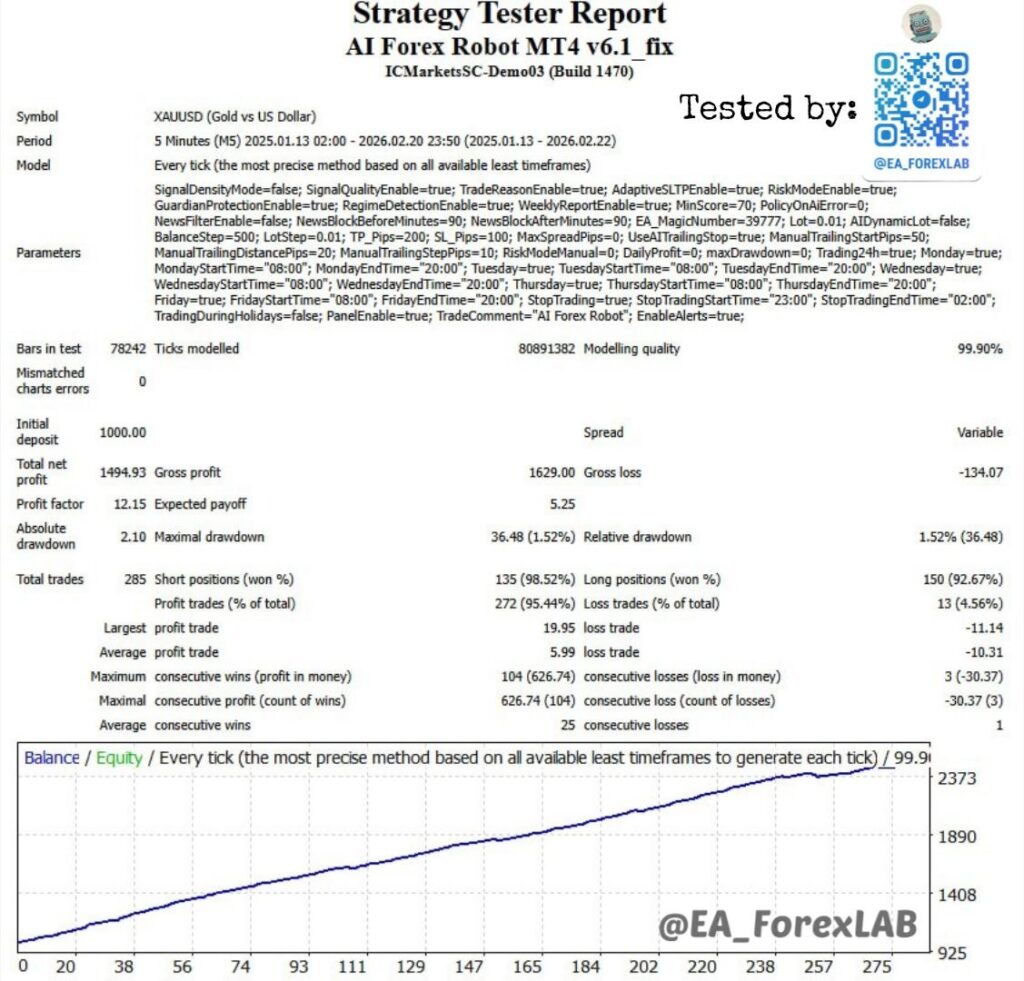
The backtest I analyzed was run through Tick Data Suite. It used real tick data from the Darwinex broker, executed on an IC Markets terminal. The modeling quality was 99.90%. This is a solid testing method. The problem is not the method. The problem is what the test actually shows.
AI Forex Robot Review: The Headline Numbers
Here are the key results from the backtest:
| Metric | Value |
|---|---|
| Symbol | XAUUSD (M5) |
| Period | Jan 13, 2025 – Dec 2025 |
| Initial Deposit | $1,000 |
| Total Net Profit | $1,494.93 |
| Gross Profit | $1,629.00 |
| Gross Loss | -$134.07 |
| Profit Factor | 12.15 |
| Expected Payoff | $5.25 |
| Total Trades | 285 |
| Win Rate | 95.44% |
| Largest Win | $19.95 |
| Largest Loss | -$11.14 |
| Average Win | $5.99 |
| Average Loss | -$10.31 |
| Maximal Drawdown | $36.48 (1.52%) |
At first glance, these numbers look amazing. A profit factor of 12.15 is very high. A 95% win rate is impressive. A drawdown of just 1.52% looks incredibly safe.
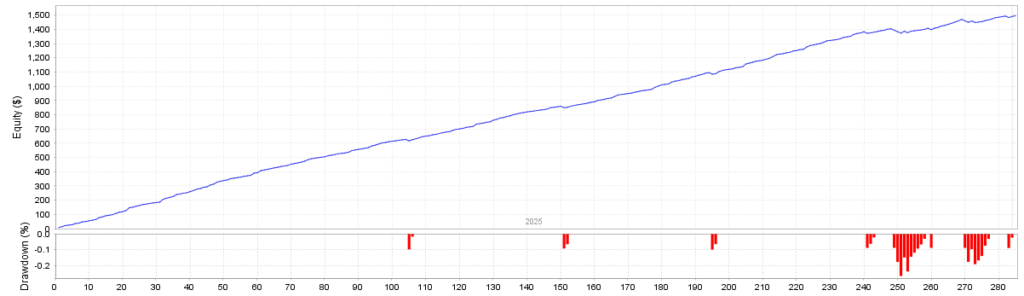
But experienced traders know to be careful here. Numbers this clean are a warning sign, not a guarantee. They almost always mean the test period was short, or the conditions were ideal, or both. In this case, it is both. Let me show you why.
The Biggest Problem: An 11-Month Backtest
This is the single most important point in this AI Forex Robot review, so read it closely.
The report header says the test runs from January 2025 to February 2026. But the actual trade data tells a different story. The last real trade closed on December 12, 2025. That means the backtest covers only about 11 months of live trading activity.
Eleven months is not enough to judge any trading system. Professional traders want to see at least three to five years of data. They want to see how a strategy behaves in different market conditions: trends, ranges, crashes, and recoveries.
Why does this matter so much for gold? Because 2025 was one of the strongest gold bull markets in history. Gold rose from around $2,600 to well above $3,000 during the test period. The price moved up in a clean, strong trend for most of the year.
A short-term gold strategy will almost always look good in a year like that. The real test is what happens when gold stops trending. What happens in a sideways market? What happens in a sharp crash? The backtest gives us no answer, because those conditions are simply not in the data.
How the AI Forex Robot Actually Trades
To understand the risk, you need to understand how this EA works. I reconstructed all 285 trades from the file. Here is what I found.
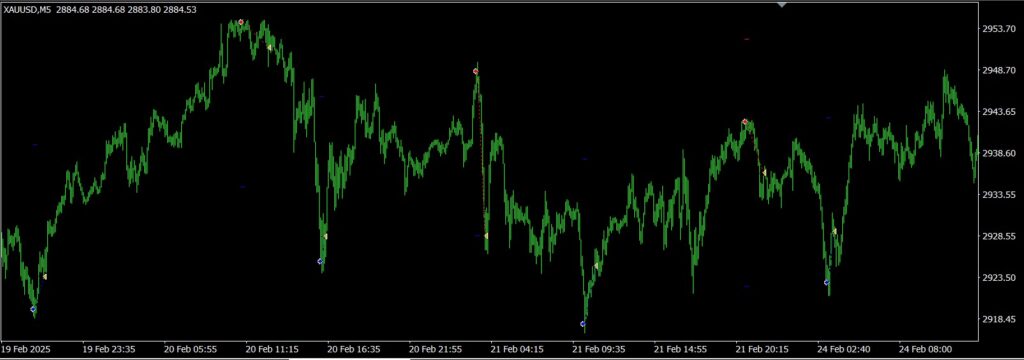
The EA opens trades with a fixed stop-loss of about 100 pips. That equals roughly $10 of risk per trade at the minimum 0.01 lot size. The take-profit target is set at 200 pips. So on paper, the risk-to-reward ratio looks like 1:2, which is healthy.
But the real behavior is different. The EA uses a trailing stop. I counted 1,026 stop-loss modifications across the test. This means the EA constantly moves its stop-loss to lock in profit as a trade goes its way.
The result is interesting. Out of 285 trades, 282 closed at the stop-loss level, not the take-profit. But most of those “stop-loss” closes were actually small profits, because the trailing stop had already moved into positive territory.
Here is the catch. The average winning trade was only $5.99. That is about 60 pips. But the take-profit target was 200 pips. So the trailing stop closes most trades early, locking small wins. The system rarely lets a trade run to its full target.
This is the classic scalping trade-off. You win often, but you win small. And when you lose, you lose more than you win. The average loss of $10.31 is nearly double the average win of $5.99.
Why a 95% Win Rate Can Be Misleading
A 95% win rate sounds like a near-perfect system. But the math underneath tells a more careful story.
Think about it this way. The EA wins small ($5.99) and loses bigger ($10.31). To stay profitable, it must win very often. And it does, as long as the market behaves.
Let me show you how fragile this is. Here is the expected profit per trade at different win rates:
| Win Rate | Expected Profit per Trade |
|---|---|
| 95% (backtest) | $5.18 |
| 90% | $4.36 |
| 85% | $3.55 |
| 80% | $2.73 |
| 70% | $1.10 |
| 63% | -$0.04 |
At a 95% win rate, the system earns about $5 per trade. That is great. But if the win rate falls to 63%, the system stops making money. Below that, it loses.
Now here is the warning sign from the data itself. The win rate was not stable across the test. Look at the monthly numbers:
| Month | Trades | Win Rate | Profit |
|---|---|---|---|
| Jan 2025 | 14 | 100% | $82.33 |
| Feb 2025 | 24 | 100% | $166.70 |
| Mar 2025 | 22 | 100% | $143.88 |
| Jun 2025 | 27 | 100% | $154.80 |
| Oct 2025 | 23 | 100% | $149.46 |
| Nov 2025 | 36 | 83% | $131.07 |
| Dec 2025 | 17 | 76% | $35.94 |
For most of 2025, the win rate was near 100%. But in the last two months, it began to drop. November fell to 83%. December fell to 76%, and profit dropped sharply to just $35.94.
This is exactly what you would expect as a strong trend starts to fade. The most recent data is the weakest data. That is not a good sign for what comes next.
AI Forex Robot Review: The News Filter Was Off
Here is a detail that the marketing never mentions. The vendor proudly lists an “Economic News Filter” as a key feature. They say it blocks trades before and after major news events.
But in the backtest, this filter was turned off. The setting NewsFilterEnable=false is right there in the parameters.
Why does this matter? Gold reacts violently to news. Events like the US jobs report, inflation data, and Fed meetings can move gold by $20 to $50 in seconds. Spreads explode during these moments. Slippage becomes severe.
A scalping system with a tight 100-pip stop-loss is very exposed to these spikes. With the news filter off, the backtest may have caught some lucky moves. But it also avoids showing how the filter would change the results. We simply do not know how the EA performs with its own safety feature switched on.
This is a transparency problem. If the news filter is a core feature, it should be tested with the feature active.
The Spread Filter Was Also Disabled
There is a second hidden setting worth your attention. The parameter MaxSpreadPips=0 means the spread filter was effectively disabled during the test.
A spread filter blocks trades when the spread is too wide. This protects you during low-liquidity periods and news spikes. With it set to zero, the EA would trade in any spread condition.
The backtest used variable spread on tick data Darwinex on the terminal IC Markets. That broker has some of the tightest gold spreads in the world, often 0.1 to 0.3 pips during active hours. Most retail traders do not have spreads this low.
So the test shows a best-case scenario. On a normal broker with wider spreads, the small $5.99 average win shrinks fast. If your typical spread is even 0.3 pips wider than Darwinex, you lose a meaningful slice of every trade. Over 285 trades, that adds up.
The Trade Timing Tells a Story
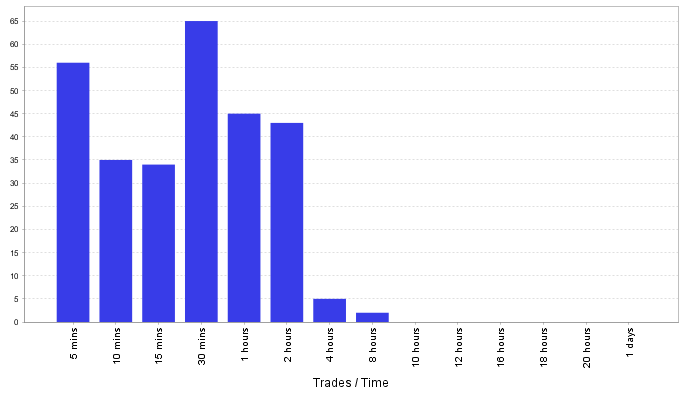
I looked at how long the EA holds its trades. The data shows it is a true scalper. Most trades close within 5 to 30 minutes. The average hold time is just 30 minutes. The longest trade lasted under 6 hours.
This fast trading style depends heavily on clean execution. It needs tight spreads, low slippage, and a fast connection. In a backtest, all of these are perfect. In live trading, they are not.
The Trades by Time chart confirms this. The biggest cluster of trades closes in the 30-minute window, followed by 5-minute and 1-hour windows. There are almost no trades held longer than 8 hours. This is a system built for quick, small wins.
The danger with scalpers is simple. Their edge is thin. A small change in real-world costs can erase the whole edge. And we have already seen two cost protections (news filter and spread filter) were switched off in the test.
The Long-Short Balance Looks Healthy
Let me give the EA credit where it is due. The trade direction split is balanced. The backtest shows 150 long trades and 135 short trades. That is roughly 53% long and 47% short.
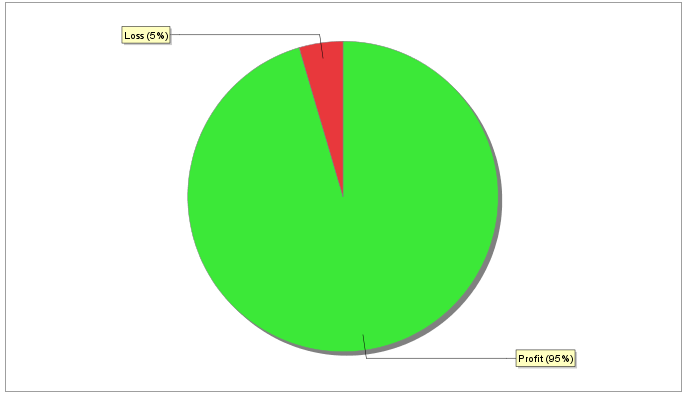
This is a good sign. It means the system is not just betting on gold going up. It trades both directions. The short win rate was 98.52% and the long win rate was 92.67%. Both sides worked during the test.
A balanced long-short approach is healthier than a one-sided one. It suggests the EA reacts to price action rather than holding a fixed bias. This is one of the more genuine positives in the data.
But remember the context. Even balanced trading was tested only in a bull market. We still do not know how the short side performs during a sustained gold downtrend, because there was no such downtrend in the test.
The “LSTM Transformer AI” Claim
The vendor leans heavily on artificial intelligence in its marketing. They describe a “hybrid LSTM Transformer neural network” optimized with “Bayesian Optimization.” These are real machine learning terms. But they are used here as selling points, and we cannot verify them.
There is no way to confirm what the EA actually does inside. The compiled code is closed. The settings we can see are standard trading parameters: stop-loss, take-profit, trailing distance, session times, and filters. None of these prove an AI model is running.
Here is the honest position. The EA might use a neural network. Or it might use rule-based logic wrapped in AI marketing language. The terms “LSTM” and “Transformer” sound advanced, but they do not guarantee better results. Many systems claim AI today because it sells. The data, not the label, is what matters.
And the data shows a scalping strategy that depends on a strong trend. That is not unique. It is not “the only system of its kind in the world.” It is a competent gold scalper tested in a friendly market.
What the $2,199 Price Really Buys
Let me be direct about the price. At $2,199, this is one of the more expensive retail EAs on the market. For that money, you should expect strong proof of long-term, real-world performance.
What you actually get is an 11-month backtest in ideal conditions. The vendor says live results are on their website, but a public, verified, long-term track record through different market types is what truly matters. A short backtest in a bull market does not justify a $2,199 price.
Compare this to the risk. The system has a thin edge. It depends on a high win rate. That win rate was already falling in the last two months of the test. The protective filters were off. And gold may not trend as strongly in the future as it did in 2025.
For beginners especially, this is a lot of money to risk on a system with so little long-term proof.
AI Forex Robot Review: Your Pre-Purchase Checklist
If you are still thinking about this EA, here is a simple checklist. Work through every point before you spend a single dollar.
First, demand a long live track record. Ask for at least two to three years of verified results. An 11-month backtest is not enough. A real account through different market conditions is what counts.
Second, understand the win-rate risk. The system needs to win about 63% of trades just to break even. It was already slipping toward that in December 2025. Plan for the win rate to fall in live trading.
Third, test with the news filter ON. The backtest had it off. Run your own test with the filter active to see the real impact. A core safety feature should be part of the test.
Fourth, account for your real spreads. The test used ultra-tight IC Markets spreads. Your broker is likely wider. Every extra pip eats into the small $5.99 average win.
Fifth, start with the smallest lot size. Use 0.01 lots for at least three to six months. Do not scale up until you see real, stable results in live conditions.
Sixth, watch the most recent performance, not the best months. The early 2025 months looked perfect. The latest months looked weak. Judge the system by its newest data, not its best.
Final Verdict: A Smart Scalper in a Perfect Market
Let me sum up this AI Forex Robot review in plain terms.
The AI Forex Robot is a competent gold scalping system. It has a real strategy. It uses a sensible trailing stop. It trades both long and short. Its backtest was run with a proper, high-quality method. These are genuine positives, and I will not pretend otherwise.
But the concerns are serious, and they outweigh the shine of the headline numbers.
The backtest covers only 11 months. That period was one of the strongest gold bull markets ever. The news filter was off. The spread filter was off. The win rate was already falling in the final two months. The average loss is bigger than the average win, so the system depends on winning almost every time. And the price is a steep $2,199 for so little long-term proof.
For beginner traders: a 95% win rate is not a promise of safety. It is the result of a short test in a friendly market. Learn to look past the win rate to the conditions behind it.
For intermediate traders: the monthly breakdown is your key tool here. Watch how the win rate fell in November and December. That trend matters more than the perfect early months.
For experienced traders: you already know the signs. A scalper with a thin edge, protective filters disabled, and a backtest limited to a single trending year is a regime-dependent bet. Without years of verified live data, the 12.15 profit factor is not proof. It is a hypothesis built on ideal conditions.
Gold is a hard, fast, news-driven market. Systems can win in it, but only the ones that survive across many conditions are worth real money. The AI Forex Robot has not yet shown it can do that.
Trade with your eyes open.
Even more advisors with test results are presented in our advisor database.
In order to download an adviser with tests, go to our telegram channel 👇